


People are using AI more than ever, but they don’t fully trust it.
AI platforms answer quickly, but they lack real-world experience. It doesn’t test strategies or apply knowledge in practical situations. That’s why users and even search engines look for signals that go beyond generic information. They look for trust and proven expertise.
So, how do you make your content more trustworthy in an AI-driven world? One of the most effective ways is through expert quotes.
Expert quotes add real-world credibility to your content. They show that your insights are backed by people with experience and authority, helping you build AI trust, strengthen SEO, and create content that is more likely to be trusted and cited.
In this guide, you’ll learn how to use expert quotes to build AI trust and create content that both users and AI models are more likely to trust and cite.
TL;DR
- AI systems rely on attribution signals like named experts and verified credentials to evaluate content credibility; expert quotes directly supply those signals.
- Well-attributed expert quotes increase AI citation likelihood by making content easier to extract, validate, and reuse across platforms like ChatGPT, Perplexity, and Google AI Overviews.
- Industry practitioners, academics, thought leaders, and customer voices each serve a distinct trust function; choosing the right type for the right context matters.
- Integrate quotes by leading with context, attributing fully, keeping quotes concise, and always following with analysis that connects back to the argument.
- Long-term brand authority through expert quotes requires consistent sourcing, periodic audits, and continuous AI visibility monitoring to sustain citation performance over time.
Why Expert Quotes Matter for AI Citations
AI systems choose content that appears reliable, attributable, and grounded in real expertise when generating answers. While they can generate and summarize content at scale, they do not possess firsthand experience or the ability to validate claims independently. They rely heavily on signals that indicate human expertise, and that reliance is what makes expert quotes a critical trust-building element in AI search content strategy.
Expert quotes introduce real-world knowledge and identifiable authority. Attributing insights to professionals with relevant experience signals that the information is grounded in practical understanding, not a generic assumption, making the content more suitable for AI citation by reducing source uncertainty.
They also improve attribution and traceability. Content that clearly states who said what is easier for AI systems to extract, validate, and reuse. The attribution string itself, “[Expert Name], [Title] at [Organization]”, functions as a discrete trust anchor that AI can parse whether or not a link accompanies it.
Retrieval systems isolate well-structured quotes cleanly because they function as self-contained units, aligning with the patterns AI models associate with authoritative content drawn from journalism, academic writing, and institutional publishing.
AI systems are more likely to cite content that includes expert quotes because it combines authority, clarity, and verifiable attribution.
Types of Expert Quotes That Build Trust
Not all expert quotes carry equal weight. The type of voice behind a quote determines what kind of trust it signals to readers and to AI systems evaluating citation worthiness. Understanding the distinctions helps brands source the right quote for the right context.
1. Industry Practitioner’s Quote From People Doing The Work Daily
Practitioners are professionals with direct, hands-on experience in a specific field, including consultants, operators, managers, and specialists who encounter real problems and build real solutions. Their quotes carry the weight of applied knowledge.
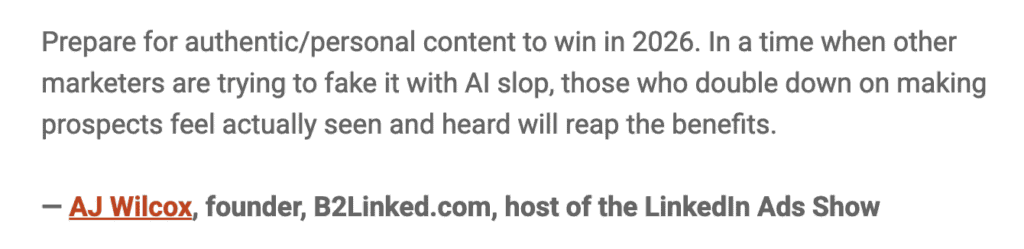
Example: AJ Wilcox, a founder and host of LinkedIn Ad Show, shares his opinion on AI slop.
2. Academics & Researchers Quote From Data-Backed Authority
Academics and researchers provide evidence-grounded perspectives backed by structured methodology. Their quotes introduce statistical credibility and institutional validation, making them among the highest-trust sources AI systems recognize.
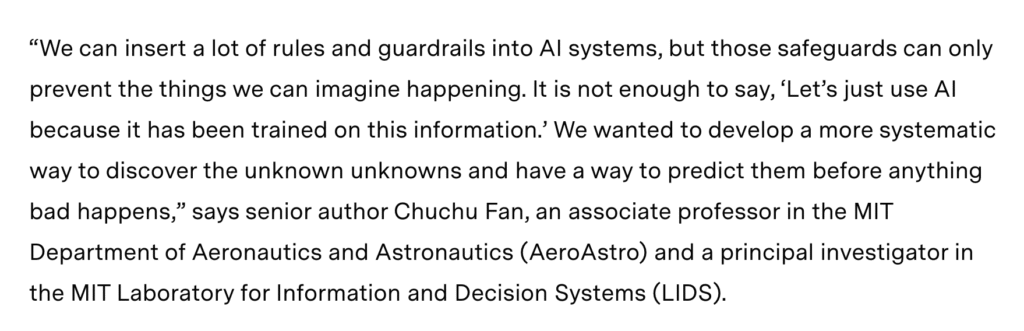
Example: A MIT professor stating expertise about using AI technologies for evaluating the ethics of autonomous systems.
 Pro Tip: Expert quotes build authority, but does that authority actually show up across AI platforms? Run a quick audit to check your AI visibility and see how expert-attributed content currently performs across AI search platforms, which citations are being earned, and where visibility gaps exist.
3. Thought Leaders Quote From Recognized Names
Thought leaders are industry figures with broad visibility, including authors, keynote speakers, founders, and analysts whose names carry recognition across platforms. Their quotes signal that a perspective has been publicly tested and peer-acknowledged.
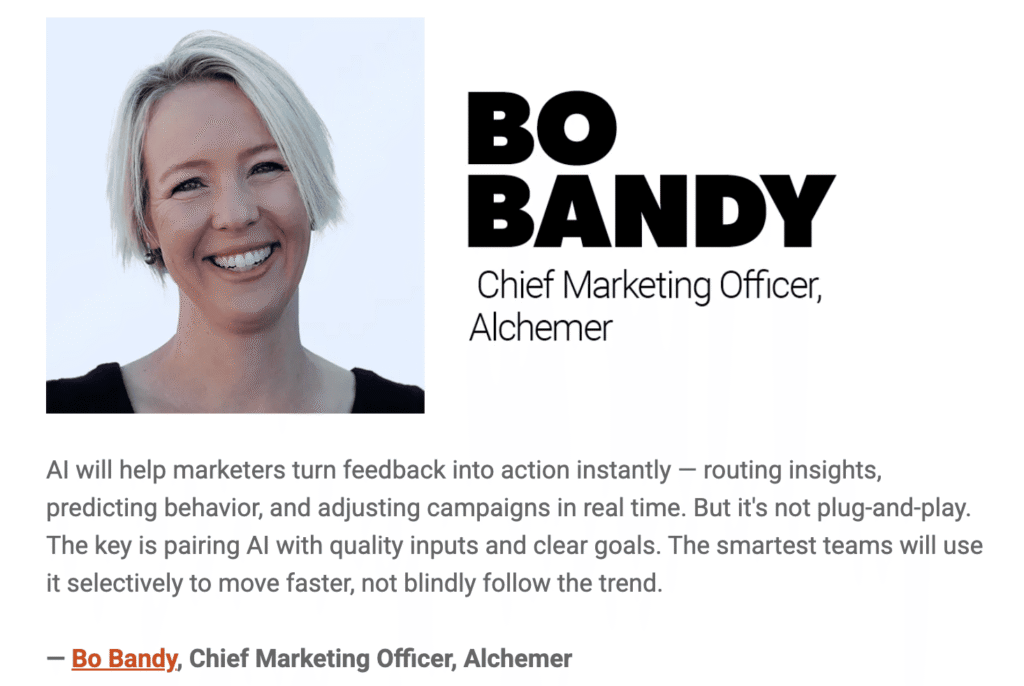
Example: Bo Bandy, Chief Marketing Officer at Alchemer, shares thoughts on how AI tools will help marketers achieve team goals.
4. Customer Or User Voices Quotes
Customer and user quotes operate differently from the other three types. They signal social proof and real-world validation. For AI systems evaluating trustworthiness, consistent positive sentiment from identifiable users reinforces brand credibility.
Example: A review for Slackbot users who used it for building AI solutions with real-time messaging.

How to Integrate Quotes Without Disrupting Content Flow
Expert quotes are effective only when integrated in a way that supports the narrative rather than interrupting it. This becomes important when designing a content optimization strategy for AI answers, where placement and structure help maintain readability while improving clarity and authority signals.
Lead with Context, Follow with the Quote
Every quote needs a setup. Before the quote lands, the surrounding copy should establish what point is being made and why the expert is relevant. This gives readers and AI systems the frame needed to interpret the quote correctly.
Here is what this looks like in practice. Distribution alone does not guarantee visibility. As Bill Gates, co-founder of Microsoft, noted in his 1996 essay on digital publishing, “Content is king.” That principle now extends to whether AI systems find that content credible enough to cite.
Attribute Quotes to Support Your Argument
The copy following the quote should connect it back to the section’s core argument. Without that follow-through, the quote reads as padding rather than proof.
The attribution format matters. “According to [Name], [Title] at [Organization]” is the minimum standard. Where possible, link the expert’s name to a verifiable profile or source. This reinforces traceability for both readers and AI retrieval systems.
Use Proper Quote Length and Placement
Shorter quotes outperform longer ones in both readability and generative AI extractability. A single declarative sentence attributed to a named expert is easier for a retrieval system to isolate than a multi-sentence block. Keep inline quotes to one to two sentences. Reserve blockquote formatting for standalone quotes that carry independent weight.
Formatting & Presentation Tips to Add Expert Quotes in Content
How a quote is presented on the page affects both reader trust and AI extractability. When optimized correctly, these formatting decisions help you rank in AI search by signaling credibility at the structural level before a reader processes a single word.
- Use blockquote HTML tags for any standalone expert quote. This creates a visually distinct passage that readers notice and AI crawlers identify as a discrete, attributable unit.
- Keep blockquote text concise. One to two sentences is the standard. Longer blocks dilute the visual impact and reduce extractability.
- Add a one-line bio beneath the quote covering name, title, and organization. This mirrors the attribution format AI systems parse most reliably.
- For recurring contributors or internal subject matter experts, link the bio snippet to a full author profile page with credentials, publications, and professional profiles.
- Hyperlink the expert’s name or attribution to a verifiable external profile, such as a LinkedIn page, institutional bio, or the original publication the quote appeared in.
- Where the quote originates from a published piece, link directly to that source. This establishes a citation chain that AI systems can follow and validate.
Where to Source Expert Quotes
Sourcing strong expert quotes requires deliberate outreach and a systematic approach. The quality of a quote is only as strong as the credibility of its source, and that credibility depends on where and how it was obtained.
Brands that combine repeatable sourcing workflows with tracking AI search visibility are better positioned to produce content with consistent attribution depth, the kind AI systems recognize as reliable across an entire domain, not just a single page.
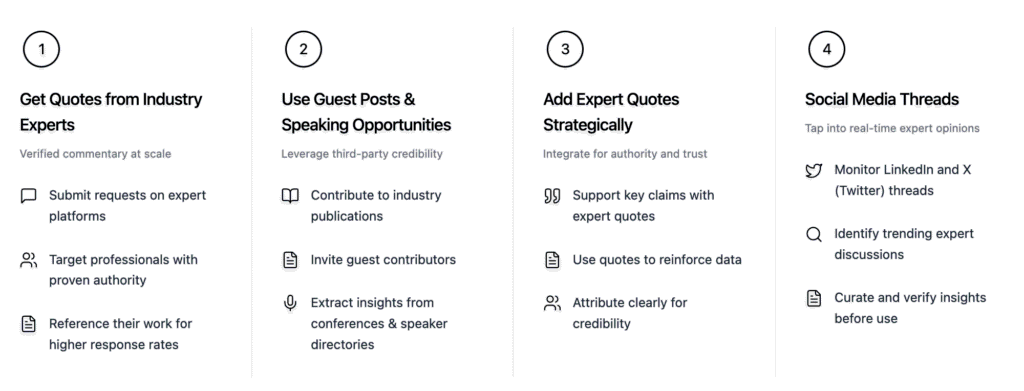
1. Get Quotes from Industry Experts and External Sources
Journalist query platforms and direct outreach remain the most reliable channels for sourcing verified expert commentary at scale.
- Use platforms such as Qwoted and HARO to submit requests for expert commentary from verified professionals actively looking to contribute.
- Reach out directly to professionals whose published work, conference talks, or LinkedIn activity demonstrates topical authority. Specific, targeted outreach yields higher response rates than open-ended requests.
- For data-backed authority, contact researchers through institutional directories or ResearchGate, referencing their published work in the outreach.
2. Use Guest Posts, Publications, and Speaking Opportunities
Third-party placements and collaborative publishing create attribution that works in both directions, building the brand’s own citation profile while bringing external credibility into its content.
- Contribute expert commentary to industry publications. Third-party citations become reusable source material that strengthens both SEO authority and AI citation eligibility.
- Invite industry voices to contribute guest posts. Guest contributions bring the contributor’s credibility into the content naturally.
- Monitor conference speaker directories and event recaps for quotable insights from recognized practitioners.
3. Add Expert Quotes to Your Own Content Strategically
Internal subject matter experts are among the most accessible and underused sourcing assets available to content teams.
- Brief internal specialists on key topics and capture their insights as attributed quotes. Internal voices with verifiable credentials carry genuine E-E-A-T signals.
- Build a recurring workflow where internal experts contribute attributed statements per content piece in their domain. Consistent attribution to the same-named experts strengthens entity recognition across the content library.
- For product-led content, source quotes from customers with direct experience. Outcome-specific quotes from named users carry more attribution value than generic testimonials.
Pro Tip: Adding expert quotes is one part of a stronger E-E-A-T signal. But how well does the rest of the content hold up? The Google E-E-A-T Audit Checklist breaks down exactly where content is building trust signals and where it is leaving citation opportunities on the table.4. Social Media Threads
Public professional commentary on platforms such as LinkedIn and X is citable source material, provided the context is preserved, and permission is confirmed.
- Monitor LinkedIn posts, X threads, and industry forums for quotable insights from recognized professionals.
- Link to the original post as the source to create a traceable citation chain.
- Prioritize quotes from accounts with verified credentials. Statements from anonymous or low-authority accounts add no meaningful trust signal and offer no value for how to use expert quotes effectively.
Mistakes To Avoid When Using Expert Quotes
Expert quotes build trust only when used correctly. Avoid these common mistakes that weaken credibility and reduce citation potential.
# Mistake 1: Using Vague or Generic Quotes
Do not use quotes that state the obvious or offer no specific insight. Every quote must carry a concrete claim or observation that reflects genuine expertise. If the statement could have been generated by an AI, it does not belong in the content.
# Mistake 2: Pulling Quotes Out of Context
Always verify that the quote accurately reflects the expert’s original intent. Extracting a statement that misrepresents the source damages editorial integrity and creates inconsistencies that AI systems can detect when cross-referencing claims.
# Mistake 3: Using AI-Generated Expert Voices
Never fabricate quotes or attribute statements to invented experts. Every quote must trace back to a real statement made by a real, verifiable person. Invented attribution permanently damages the reader’s trust the moment readers identify it.
# Mistake 4: Incomplete Attribution
Always include the expert’s full name, title, and organization. Partial attribution, such as “an industry expert says,” provides no verifiable trust signal for readers or AI systems. If a source cannot be fully credited, do not use the quote.
# Mistake 5: Overloading Content With Quotes
Do not let external voices dominate the content. Original analysis should lead; quotes exist to support that analysis, not replace it. A few well-placed, fully contextualized quotes outperform a piece built around excessive attribution.
Expert Quote to Build Long-Term Brand Authority
Expert quotes contribute to long-term brand authority by consistently reinforcing credibility, expertise, and trust across content.
When insights are regularly attributed to recognized professionals, the brand becomes associated with reliable, well-supported information rather than generic or opinion-based content.
Over time, this consistency builds topical authority, strengthens search visibility, and positions the brand as a dependable source within its domain.
Expert quotes are equally important to influence brand trust at a user level. Readers are more likely to trust and return to content supported by real expertise. This increases the likelihood of being referenced by other sources, including AI platforms evaluating citation worthiness.
Building long-term authority, however, requires a system for ongoing monitoring, tracking, and measuring AI visibility to understand how content performs across AI-driven surfaces.
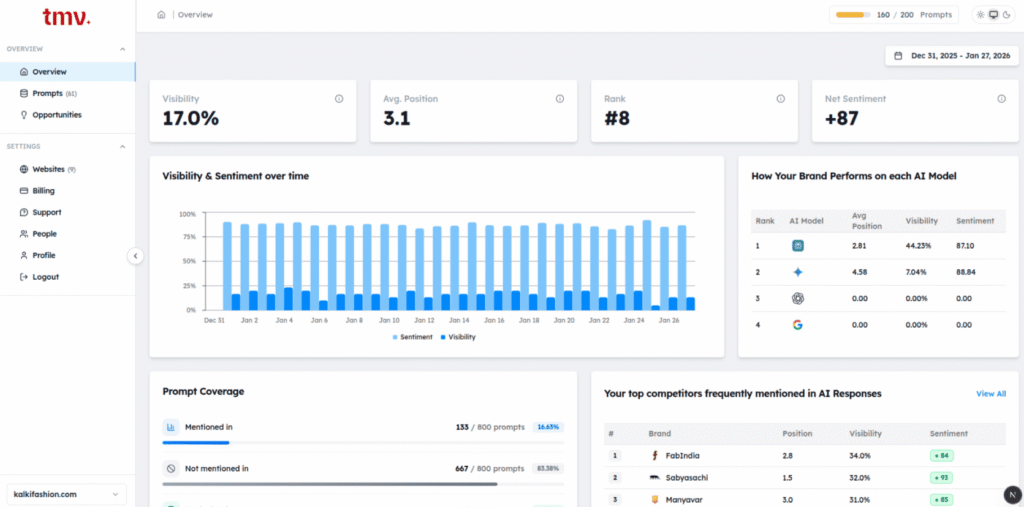
Tools like Track My Visibility help brands stay on top of this process by monitoring how expert-attributed content performs across ChatGPT, Perplexity, Gemini, and Google AI Overviews, identifying which content earns citations, where visibility is shifting, and what the content strategy needs to sustain authority over time.
Final Thoughts
Trust is hard to earn and even harder to maintain in an AI-driven search environment. While AI systems can generate and summarize content, they still rely on clear signals of expertise and credibility to decide what information to use. Expert quotes help bridge this gap by adding real-world authority and verifiable insights to content.
When content includes well-attributed expert perspectives, it becomes easier for large language models to validate, extract, and reuse. As SEO differs from AI search, this directly increases the chances of being cited in AI-generated responses, giving content greater visibility beyond traditional search rankings.
Over time, consistent use of expert quotes contributes to long-term brand credibility and authority. As content is repeatedly recognized as reliable and well-supported, it strengthens trust with both users and search systems.
The next step is to move from business execution to strategic tracking. Building trust is not a one-time effort; it requires continuous monitoring of how content performs, where it gets cited, and how brand visibility evolves across AI platforms.
Start building and measuring AI visibility today. Try our 7-day trial to monitor and track brand presence effectively.
FAQs
Expert quotes add clear attribution, authority, and real-world expertise to content. This makes information more reliable and increases its chances of being trusted and cited by AI systems.
Quotes from industry practitioners, researchers, and recognized thought leaders work best. These provide a mix of real-world experience, data-backed insights, and established authority.
Expert quotes should be concise, clearly attributed with name and role, and placed after a relevant context. Proper formatting improves readability and makes them easier for AI systems to extract.
You can source expert quotes from interviews, industry publications, guest posts, conferences, and verified social media insights, ensuring proper attribution and relevance.
Yes, expert quotes enhance content credibility, increase user trust, improve engagement signals like dwell time, and make content more likely to earn backlinks and citations.