


AI search is becoming the new front door to the internet.
Users increasingly turn to AI tools like ChatGPT, Perplexity AI, and Google Gemini to research products, compare options, and get recommendations. But these systems usually mention only a handful of brands, making visibility far more selective than traditional search.
For most businesses, the problem isn’t just visibility. It’s uncertainty. You can’t easily see whether your brand is being mentioned, which competitors are recommended instead, or which sources AI models are citing when choosing content for answers in your category.
Track My Visibility helps close that gap. It analyzes AI responses across multiple platforms to reveal when your brand is mentioned, when it’s cited, and how your visibility compares with competitors.
In this guide, we’ll walk through how Track My Visibility works and how teams can use it to monitor their brand performance across AI platforms.
TL;DR
- AI search is becoming a major discovery channel, but most brands don’t know if they appear in AI-generated answers or which sources AI models cite.
- Track My Visibility helps monitor AI visibility by tracking brand mentions, citations, and rankings across platforms like ChatGPT, Perplexity AI, and Google Gemini.
- The platform analyzes prompts, competitors, citations, and sentiment, helping teams understand how their brand performs in AI responses.
- Built-in dashboards highlight visibility trends, prompt coverage, competitor gaps, and citation sources, turning AI responses into actionable insights.
- With affordable pricing and clear reporting, TMV helps teams track, benchmark, and improve their presence in AI-driven search results.
Who Should Use Track My Visibility?
If you’re wondering whether Track My Visibility is relevant for your team, you’re not alone. As AI platforms increasingly influence how people discover brands, many teams are trying to understand where they fit into this new layer of visibility.
Track My Visibility is designed for teams that need clear insight into how their brand appears, gets mentioned, or gets cited in AI-generated answers.
- SEO Teams: SEO works differently from AI search, so SEO teams need to track which prompts trigger brand mentions or citations in AI responses to uncover visibility gaps.
- PR & Communications Teams: Monitor how AI platforms reference your brand and detect potential misinformation before it spreads.
- eCommerce & Product Brands: See whether AI assistants recommend your products or competitors during buying research.
- Marketing Agencies: Deliver AI visibility reports, competitor benchmarks, and citation insights for clients.
- Growth Leaders & Executives: Get a high-level view of brand authority, sentiment, and share of voice across AI platforms.
Does Track My Visibility Track Brand Mentions In AI?
Yes. Track My Visibility monitors how your brand appears in responses generated by AI platforms. It analyzes AI-generated answers to identify two key signals of visibility: brand mentions and citations.
Brand Mentions
Track My Visibility detects when your brand name appears in an AI-generated response, even if there is no link attached. This shows when AI models are recommending or referencing your brand in conversations.
Citations
Track My Visibility also tracks when AI platforms cite your website or content as a source in their responses. Citations indicate that the AI model is using your content to support or generate its answer.
By tracking both mentions and citations, Track My Visibility helps teams understand not just whether their brand appears in AI answers, but also whether their content is being used as a trusted source.
How the Track My Visibility Works: Onboarding Process
Getting started with Track My Visibility is designed to be simple. The platform analyzes your brand, generates relevant prompts, and begins tracking how AI models mention or cite your brand across conversations.
Here is the typical onboarding workflow.
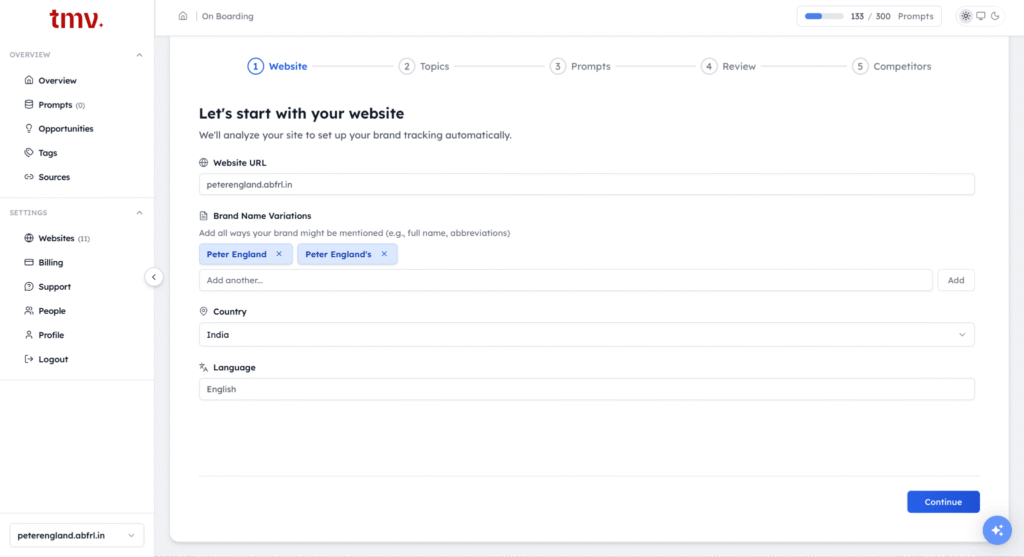
1. Sign Up and Add Your Website
The first step is to enter your brand’s website URL. Once added, TMV automatically analyzes the domain to understand:
- product categories
- content topics
- brand context
This automated scan helps the platform prepare relevant topics and prompt suggestions without requiring manual setup.
2. Select Topics
Based on the website analysis, TMV suggests topics connected to your brand’s offerings and content themes.
These may include product categories, industry topics, and customer use cases. You can pick from suggested topics or add your own.

 Pro Tip: Not all topics carry equal weight in AI search. Some content categories get cited significantly more than others across platforms. Knowing which ones before selecting topics can change what the tracking data surfaces. See what the numbers say in AI search statistics 2026.
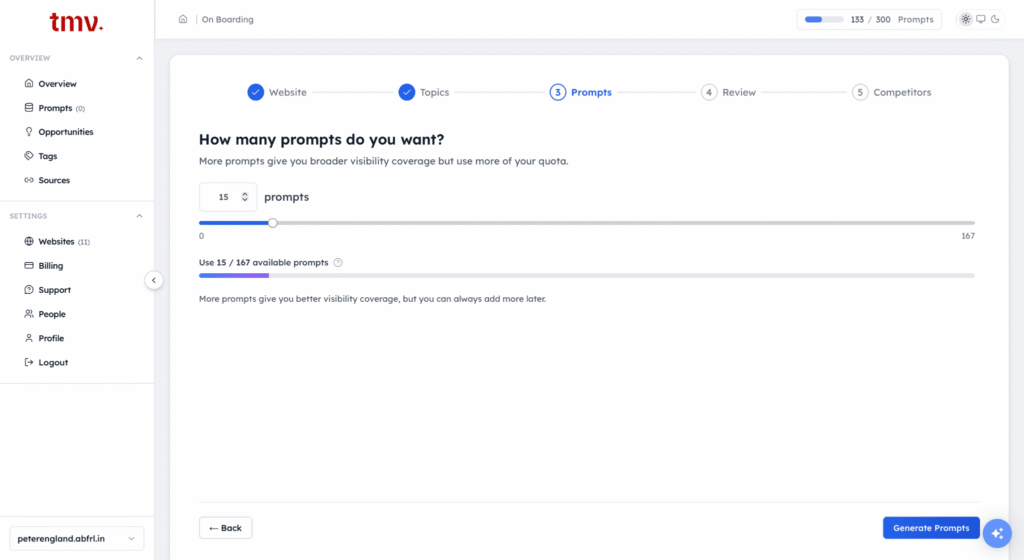
3. Generate or Add Prompts
Once topics are selected, TMV generates AI-style prompts that real users ask platforms like ChatGPT, Perplexity AI, and Google Gemini.
You can control the number of prompts using a prompt slider, depending on your plan limits.
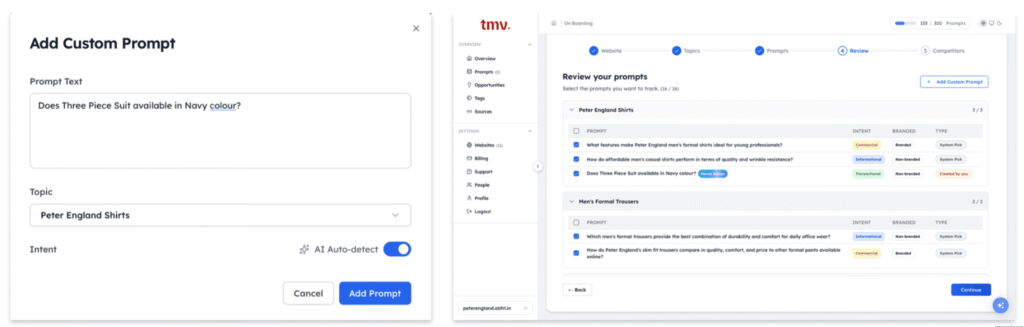
Each prompt includes useful metadata such as:
- Intent: Informational, Commercial, or Transactional
- Brand Type: Branded or Non-branded
- Prompt Source: System-generated or custom
You can also add custom prompts manually. TMV automatically detects the intent using AI.
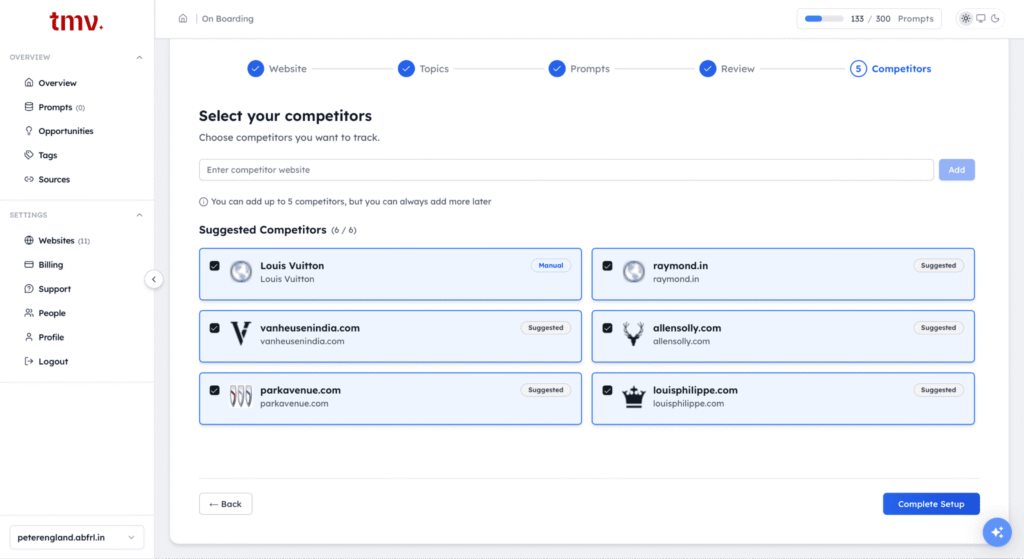
4. Select Competitors
Next, TMV suggests competitors based on your website analysis.
During onboarding, you can select up to 5 competitors and can add additional competitors later.
Once added, TMV tracks your brand and competitors side-by-side across AI platforms, helping you understand who gets recommended more often in AI responses.
What Happens Next?
After onboarding is complete, TMV begins running prompts across AI platforms and starts tracking brand mentions, citations, visibility, and sentiment. These insights appear in the TMV dashboard, where you can monitor performance, competitor rankings, and AI visibility trends.
Watch this quick walkthrough to get started:
Track My Visibility Demo (Ver. 1.0) | How to Measure AI Visibility
TMV Features – Dashboard Analysis Guide
Once onboarding is complete, Track My Visibility begins analyzing AI responses and organizing insights inside the dashboard. Each section helps teams understand where their brand appears, how competitors perform, and where visibility can improve. These insights help teams to design content optimization strategies for AI answers.
1. Overview Dashboard
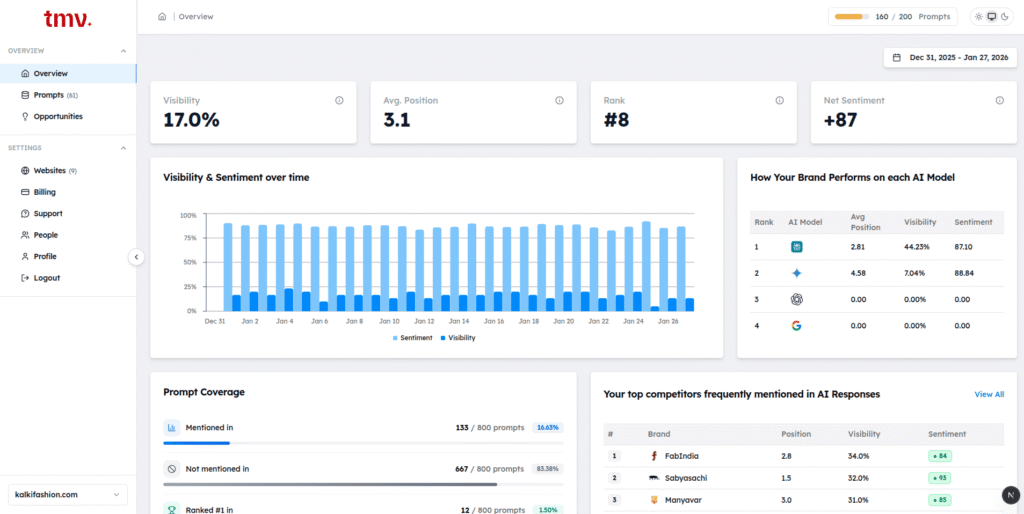
Measures: Overall AI visibility score, average brand ranking in responses, and net sentiment.
Description: A high-level snapshot of how your brand performs across all tracked prompts and AI platforms.
How to interpret: Use this as a quick health check for your brand’s overall AI visibility and perception.
2. Visibility & Sentiment Over Time
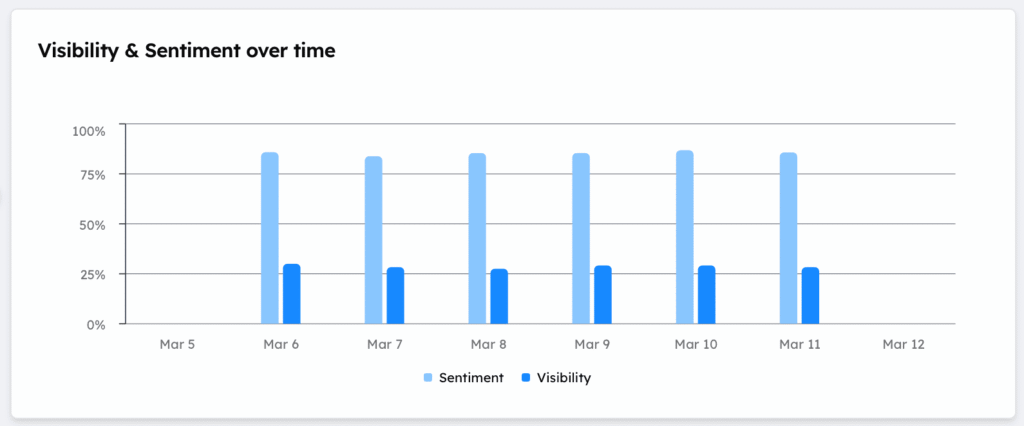
Measures: Changes in brand visibility and sentiment across tracked prompts over time.
Description: A time-series chart showing whether your brand is appearing more or less frequently in AI answers.
How to interpret: Identify trends and measure the impact of content or SEO improvements on AI visibility.
3. Brand Performance by AI Model
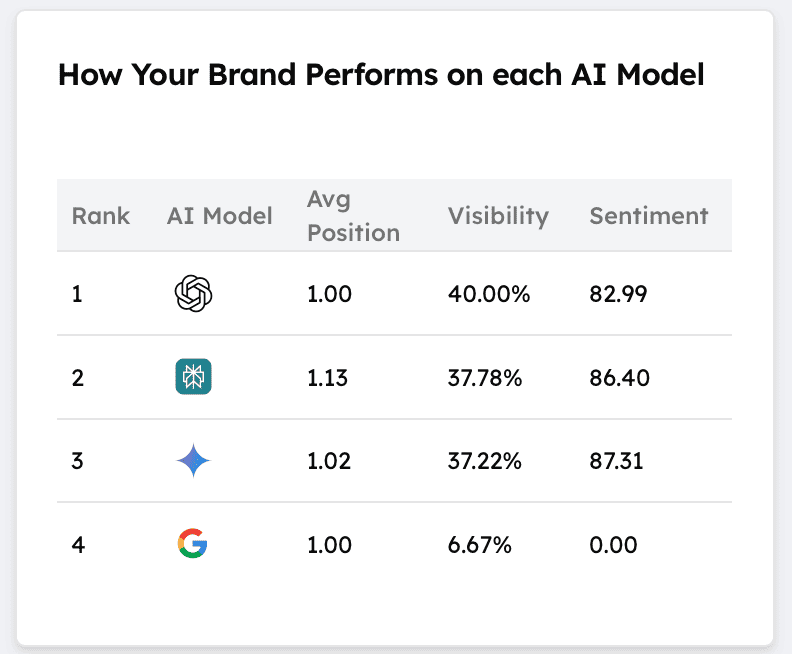
Measures: Brand ranking and appearance frequency across AI platforms such as ChatGPT, Perplexity AI, and Google Gemini.
Description: A model-level comparison showing how different AI systems mention or recommend your brand.
How to interpret: Understand where your brand performs well and which AI models require more visibility efforts.
4. Prompt Coverage
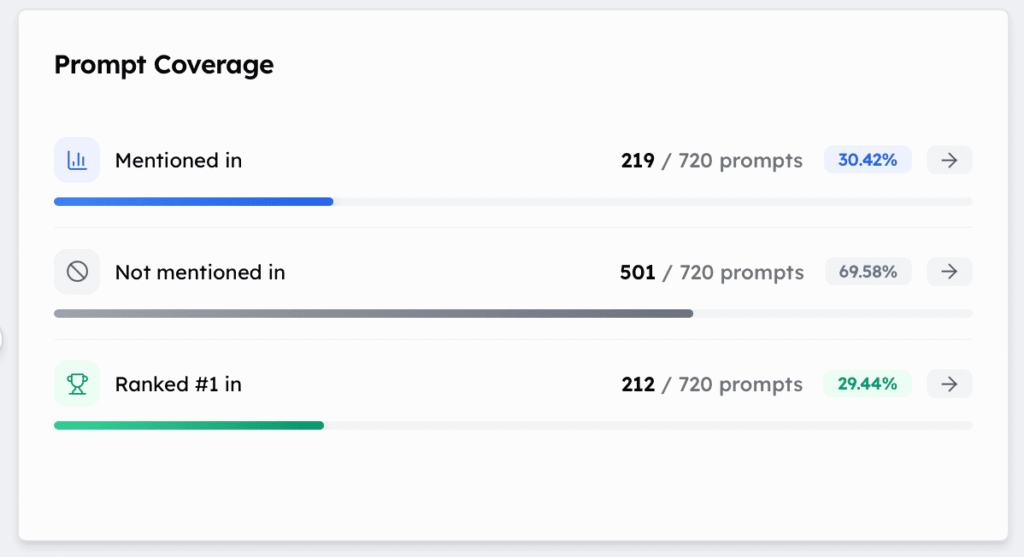
Measures: Number of prompts where the brand is mentioned, not mentioned, or ranked.
Description: Shows coverage across all tracked prompts and highlights where the brand appears in AI responses.
How to interpret: Quickly identify prompts where your brand is missing and where it already performs well.
5. Competitor Benchmarking
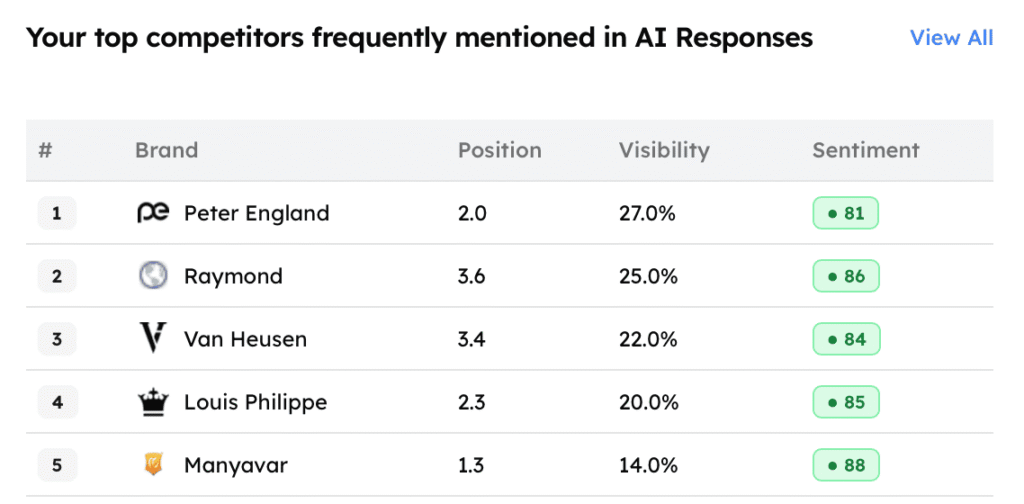
Measures: Visibility and ranking comparison between your brand and selected competitors.
Description: Displays how frequently competing brands appear across the same prompts.
How to interpret: Understand which competitors dominate AI answers in your category.
Pro Tip: Don’t want to lose AI visibility for your brand? See where your brand already appears in AI responses and where it doesn’t. Those gaps often reveal the biggest opportunities. Run a quick audit and get your free AI visibility report to see how your brand currently shows up across major AI platforms.6. Prompts Dashboard
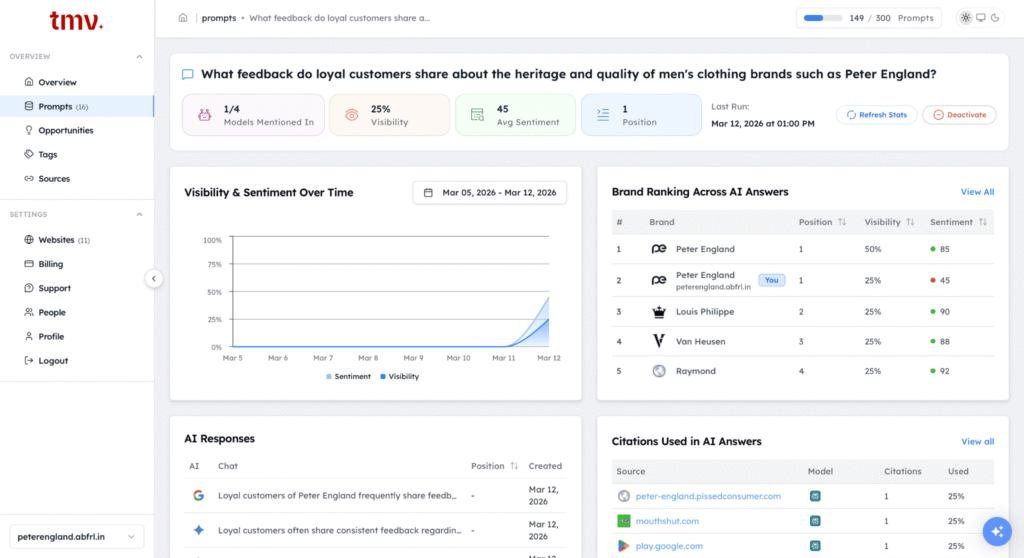
Measures: Active prompts, AI models mentioning the brand, last run timestamp, and geographic targeting.
Description: A full list of all tracked prompts used to test AI visibility.
How to interpret: Monitor prompt activity and ensure the tracking reflects real user questions.
7. Prompt-Level Analysis

Measures: Brand mentions per prompt, brand ranking within AI answers, citations used, and generated AI responses.
Description: Detailed analysis of how a specific prompt performs across different AI models.
How to interpret: Review the actual AI responses to understand why certain brands appear or rank higher.
8. Opportunity Zone
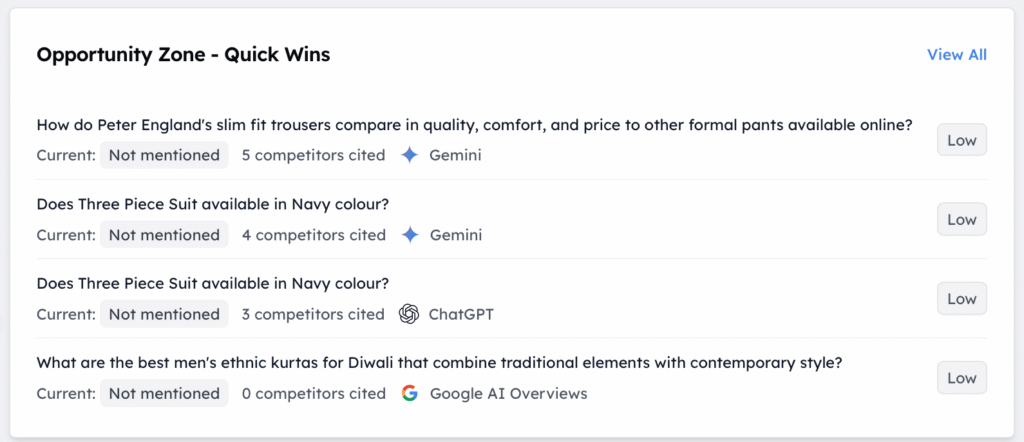
Measures: Optimization opportunities categorized into on-page, off-page, and technical improvements.
Description: A recommendation layer highlighting areas where visibility can be improved. This helps the team to design strategies for ranking in AI search visibility.
How to interpret: Use these insights to guide SEO, content strategy, and authority-building efforts.
9. Competitive Gap Analysis
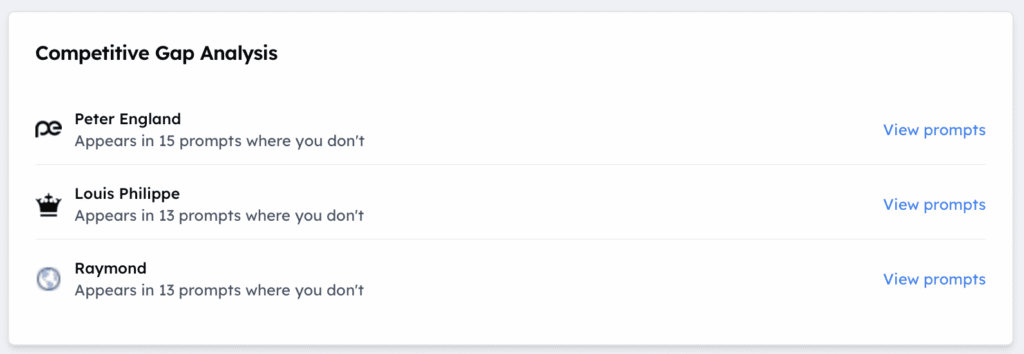
Measures: Prompts where competitors appear but your brand does not.
Description: Identifies missed visibility opportunities across tracked prompts.
How to interpret: Prioritize these prompts to improve coverage and compete for AI recommendations.
10. Sources Dashboard
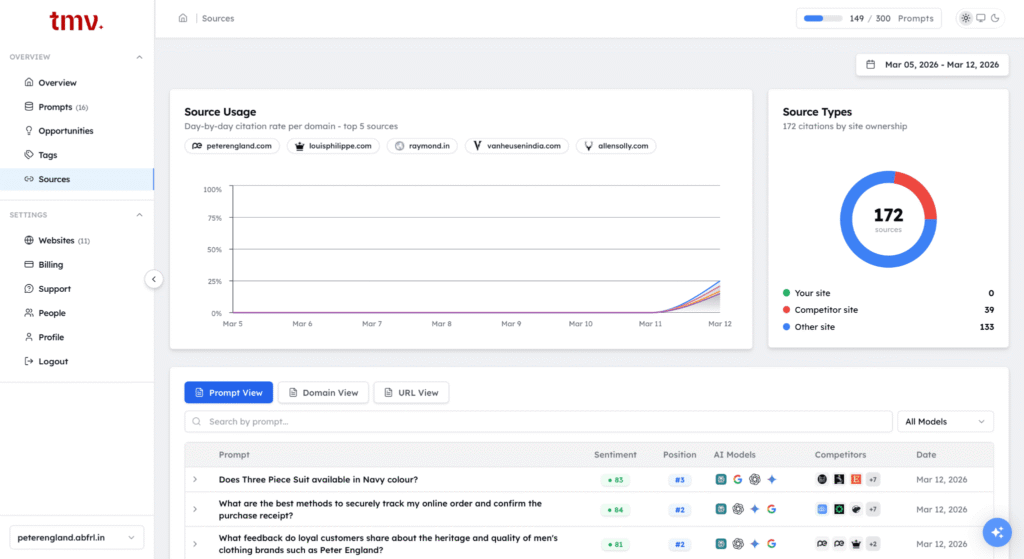
Measures: All URLs cited by AI platforms across tracked prompts.
Description: A comprehensive list of external pages and domains that AI models reference.
How to interpret: Analyze which content sources influence AI-generated answers.
11. Citation Quality
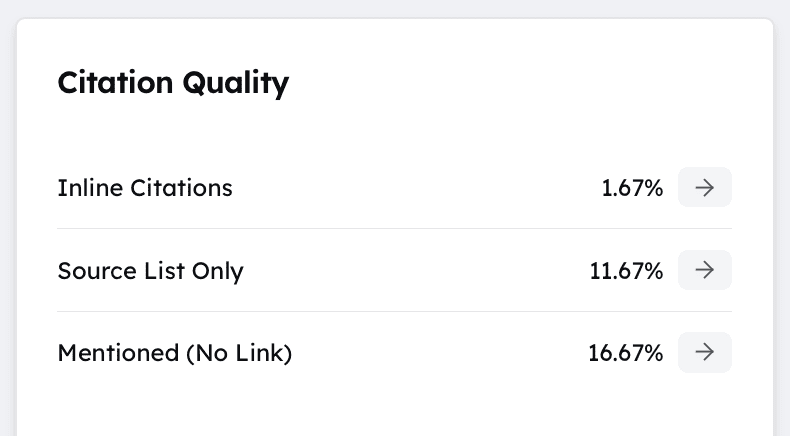
Measures: Type of citation used in AI responses (inline citations, source-only references, brand mentions without links)
Description: Evaluates how AI models reference your brand or content in their answers.
How to interpret: Determine whether AI platforms treat your site as a primary source, supporting reference, or simple mention.
Pro Tip: Refining a prompt list is easier when there is a clear picture of which sources are cited in AI-generated answers. Review this comprehensive AEO GEO audit checklist for citation signals to identify which prompts are worth tracking.Pros and Cons of Track My Visibility
Track My Visibility is built to help teams understand how their brand appears across AI search platforms and where visibility opportunities exist. While the platform provides deep prompt-level insights, citation tracking, and optimization recommendations, it’s important to evaluate how well it aligns with your workflow and monitoring needs.
Pros:
- Citation-level intelligence
Goes beyond simple brand mentions by distinguishing between inline citations, source-list citations, and unlinked mentions, giving a clearer picture of how AI models reference your brand. - Opportunity Zone insights
Highlights prompts where competitors are cited, but your brand is missing, helping teams prioritize visibility improvements. - Source audit visibility
Shows which third-party URLs AI platforms cite, helping inform off-site content and authority-building strategies. - Accessible pricing
Entry plans start at free, making AI visibility tracking accessible for smaller teams and startups. - Custom prompt support
Allows teams to add their own prompts, with AI automatically detecting and classifying intent.
Cons:
- Early-stage visibility data
Brands new to AI search may initially see low mention or citation counts, and meaningful trends take time to build. - Prompt-based tracking model
Visibility insights depend on the set of prompts being monitored, so coverage improves as more relevant prompts are added. - Prompt quota limitations
Each plan includes a prompt limit, meaning broader monitoring requires higher plan tiers. - Limited long-term benchmarks
Since AI search visibility is still emerging, industry-wide historical benchmarks are still developing.
How Much Does It Cost?
Many tools in the emerging AI SEO and AI visibility tracking space come with enterprise-style pricing. For smaller teams, startups, or agencies just beginning to explore AI search monitoring, these tools can quickly become expensive and difficult to justify.
But Track My Visibility takes a different approach. Instead of positioning AI visibility tracking as an enterprise-only capability, TMV makes it accessible and affordable to track AI search visibility, with plans starting at one of the lowest price points in the market, with a free trial.
The platform also offers two months free on the yearly Growth plan, making long-term tracking even more cost-effective.
TMV Pricing Plans
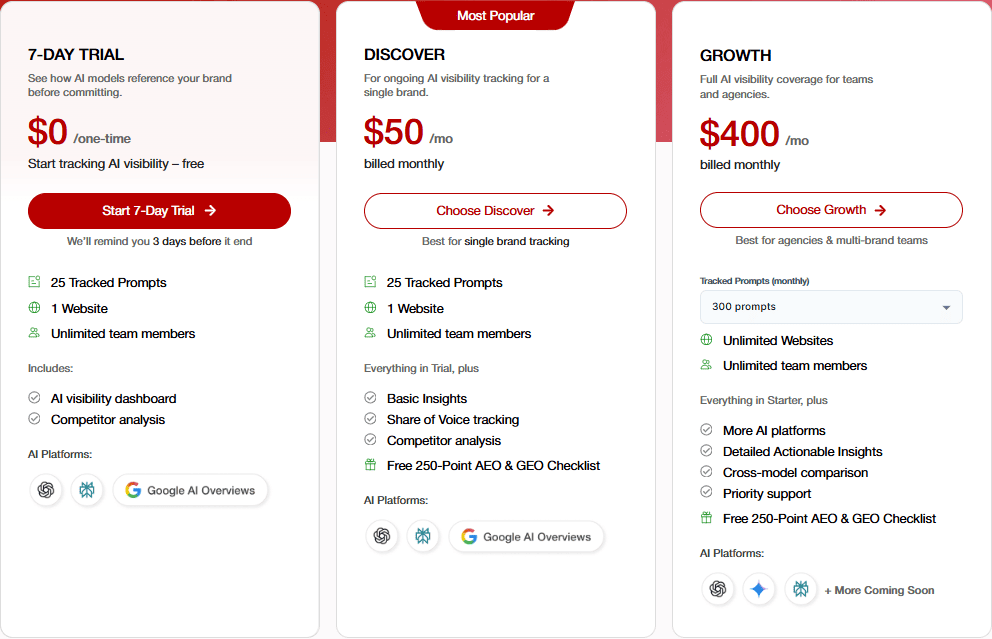
- Discover Plan: $42/month
Designed for individuals or small teams starting to monitor brand visibility in AI search. - Growth Plan: $83/month
Includes expanded prompt tracking and more advanced monitoring features.
Yearly billing includes 2 months free.
These flexible plans make Track My Visibility accessible whether you’re experimenting with AI visibility tracking or running ongoing monitoring across multiple prompts and competitors.
Note: Refer to the updated pricing page for further breakdown.
Is AI Visibility Tracking Worth It? Calculating the ROI with Track My Visibility
Calculating the ROI of a monitoring platform is not always straightforward. Tools like Track My Visibility don’t directly generate sales the way paid ads do. Instead, their value lies in providing the intelligence needed to make better strategic decisions when measuring AI search visibility.
You can think about the ROI in a few practical ways:
# Operational Efficiency
Manually checking dozens of prompts across AI platforms like ChatGPT, Perplexity AI, and Google Gemini would take hours every week. TMV automates this monitoring, allowing teams to focus on strategy rather than manual tracking.
# Competitive Visibility Insights
AI answers often recommend only a few brands. Knowing when competitors begin appearing more frequently for important prompts allows teams to identify visibility shifts early and respond quickly.
# Brand Monitoring in AI Responses
AI models shape perception. If your brand is misrepresented or simply missing from key conversations, it can impact awareness and trust. TMV acts as a visibility monitoring layer, helping teams track how their brand is presented in AI responses.
While the financial return can be hard to measure directly, the cost of AI visibility tracking is relatively low compared to the strategic insights it provides.
With entry pricing starting at just a few dollars per month, Track My Visibility offers an accessible way to monitor a channel that is quickly becoming a major discovery layer on the internet.
If AI platforms influence how customers discover brands, you cannot afford not to track your visibility.
What Makes Track My Visibility Unique?
Many AI visibility tools track mentions. Track My Visibility focuses on making the process simpler, more actionable, and easier to adopt for teams monitoring AI search performance.
# Automated Prompt Discovery
Instead of forcing teams to guess what prompts to track, TMV analyzes your website and suggests relevant topics and prompts automatically, helping you start monitoring the questions real users ask AI systems.
# Fast, Intuitive Setup
The platform is designed to be easy to navigate. Most teams can set up tracking, add prompts, and start monitoring AI responses within minutes, without complex configuration or long onboarding.
# Source-Level Visibility
The Sources dashboard reveals which exact URLs AI platforms cite in their answers. This helps teams identify trusted sources influencing AI responses and uncover opportunities for content improvement or outreach.
# Actionable Visibility Insights
Rather than just showing mentions, TMV highlights where competitors appear, but your brand does not, turning visibility gaps into clear optimization opportunities.
# Accessible Pricing
AI search monitoring tools are often priced for large enterprises. TMV takes a different approach by offering affordable entry-level plans, making AI visibility tracking accessible for startups, agencies, and growing teams.
“The goal of Track My Visibility is not just to track mentions, but to give teams the intelligence needed to understand where their brand stands in the emerging AI search ecosystem.” – Piyush Lathiya
Ready To Monitor Your AI Visibility
Ranking in AI search doesn’t happen overnight. It takes time to build presence, and tracking how your brand appears across different AI platforms can quickly become complicated.
If your brand is still new and building its digital presence, AI visibility may be limited at first. That’s expected. The important part is discovering where you stand today and where opportunities exist to start appearing in AI answers.
Track My Visibility helps to make your brand visible by turning AI responses into clear, actionable insights showing where your brand is mentioned, where competitors appear instead, and where the next opportunities lie.
Start tracking where your brand actually stands in AI search.
Frequently Ask Questions
Track My Visibility monitors ChatGPT, Claude, Perplexity, and Google AI Overviews the four platforms where the majority of AI-driven brand discovery is currently happening.
Prompts run once every 24 hours across all selected AI models. The dashboard shows a live countdown to the next run, so visibility trends are always current and comparable day over day.
A brand mention is when an AI response directly names the brand. A citation is when the brand’s content is used to generate an answer, even if the brand is not named. Tracking both matters because a brand can have content authority without name recognition, or name recognition without content trust. TMV measures both separately.
Yes. Competitors are added during setup and tracked across the same prompts as the brand, with position, visibility %, and sentiment scores displayed side by side. The Competitive Gap Analysis shows how many prompts each competitor appears in, where the brand does not.
Traditional rank trackers measure keyword positions in Google search results. TMV measures how AI platforms respond to conversational prompts.
Yes. TMV offers a trial tier that lets brands run an initial set of prompts and see dashboard results before committing to a paid plan. Start with a 7-day free trial.